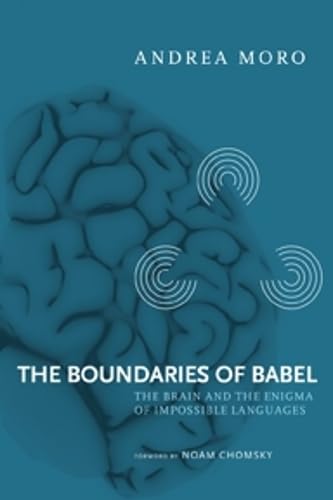
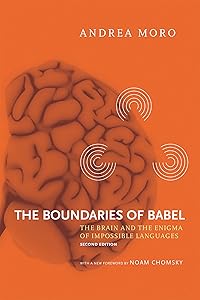
The Boundaries of Babel: The Brain and the Enigma of Impossible Languages (Current Studies in Linguistics Series) by Andrea Moro

The Boundaries of Babel: The Brain and the Enigma of Impossible Languages (Current Studies in Linguistics Series)

Andrea Moro
257 pages
Mit Pr
Jan 2008
Hardcover
All Non-Fiction WSBN
0
Readers
0
Reviews
0
Discussions
0
Quotes
An exploration of what research at the intersection of contemporary theoretical linguistics and the cognitive neurosciences can reveal about the constraints on the apparently chaotic variation in human languages.In The Boundaries of Babel, Andrea Moro tells the story of an encounter between two cultures: contemporary theoretical linguistics and the cognitive neurosciences. The study of language within a biological context has been ongoing for more than fifty years. The development of neuroimaging technology offers new opportunities to enrich the "biolinguistic perspective" and extend it beyond an abstract framework for inquiry. As a leading theoretical linguist in the generative tradition and also a cognitive scientist schooled in the new imaging technology, Moro is uniquely equipped to explore this.Moro examines what he calls the "hidden" revolution in contemporary science: the discovery that the number of possible grammars is not infinite and that their number is biologically limited. This radical but little-discussed change in the way we look at language, he claims, will require us to rethink not just the fundamentals of linguistics and neurosciences but also our view of the human mind. Moro searches for neurobiological correlates of "the boundaries of Babel"—the constraints on the apparent chaotic variation in human languages—by using an original experimental design based on artificial languages. He offers a critical overview of some of the fundamental results from linguistics over the last fifty years, in particular regarding syntax, then uses these essential aspects of language to examine two neuroimaging experiments in which he took part. He describes the two neuroimaging techniques used (positron emission topography, or PET, and functional magnetic resonance imaging, or fMRI) , but makes it clear that techniques and machines do not provide interesting data without a sound theoretical framework. Finally, he discusses some speculative aspects of modern research in biolinguistics regarding the impact of the linear structure of linguistics expression on grammar, and more generally, some core aspects of language acquisition, genetics, and evolution.
Join the conversation

No discussions yet. Join BookLovers to start a discussion about this book!

No reviews yet. Join BookLovers to write the first review!

No quotes shared yet. Join BookLovers to share your favorite quotes!

Earn Points
Your voice matters. Every comment, review, and quote earns you reward points redeemable for Bitcoin.
Comment +5 pts Review +20 pts Quote +7 pts Upvote +1 pt
BookMatch Quiz
Find books similar to this one
About this book
Pages 257
Publisher Mit Pr
Published 2008
Readers 0