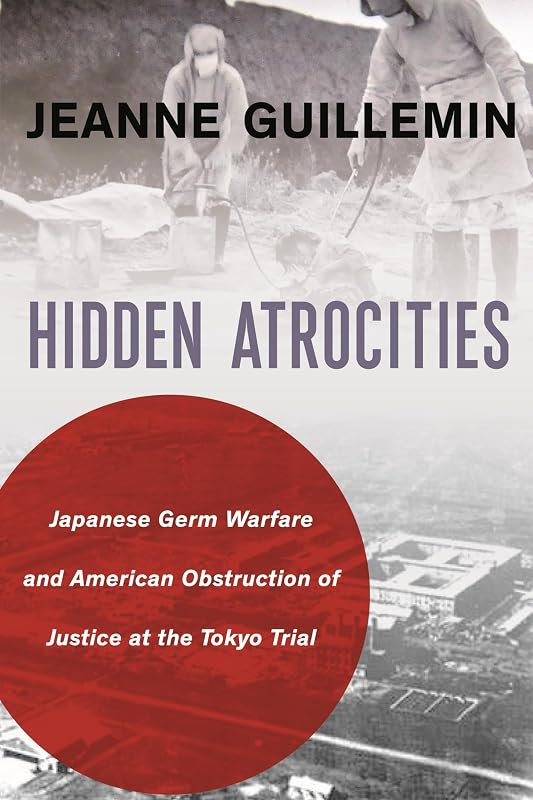

Hidden Atrocities: Japanese Germ Warfare and American Obstruction of Justice at the Tokyo Trial (A Nancy Bernkopf Tucker and Warren I. Cohen Book on American–East Asian Relations) by Jeanne Guillemin

Hidden Atrocities: Japanese Germ Warfare and American Obstruction of Justice at the Tokyo Trial (A Nancy Bernkopf Tucker and Warren I. Cohen Book on American–East Asian Relations)

Jeanne Guillemin
488 pages
Columbia University Press
Sep 2017
Hardcover
History WSBN
0
Readers
0
Reviews
0
Discussions
0
Quotes

Free account. We’ll keep this book ready while you join.

Find a copy

Formats and availability vary by store. As an Amazon Associate I earn from qualifying purchases.

In the aftermath of World War II, the Allied intent to bring Axis crimes to light led to both the Nuremberg trials and their counterpart in Tokyo, the International Military Tribunal of the Far East. Yet the Tokyo Trial failed to prosecute imperial Japanese leaders for the worst of war crimes: inhumane medical experimentation, including vivisection and open-air pathogen and chemical tests, which rivaled Nazi atrocities, as well as mass attacks using plague, anthrax, and cholera that killed thousands of Chinese civilians. In Hidden Atrocities, Jeanne Guillemin goes behind the scenes at the trial to reveal the American obstruction that denied justice to Japan's victims.. Responsibility for Japan's secret germ-warfare program, organized as Unit 731 in Harbin, China, extended to top government leaders and many respected scientists, all of whom escaped indictment. Instead, motivated by early Cold War tensions, U.S. military intelligence in Tokyo insinuated itself into the Tokyo Trial by blocking prosecution access to key witnesses and then classifying incriminating documents. Washington decision makers, supported by the American occupation leader, General Douglas MacArthur, sought to acquire Japan's biological-warfare expertise to gain an advantage over the Soviet Union, suspected of developing both biological and nuclear weapons. Ultimately, U.S. national-security goals left the victims of Unit 731 without vindication. Decades later, evidence of the Unit 731 atrocities still troubles relations between China and Japan. Guillemin's vivid account of the cover-up at the Tokyo Trial shows how without guarantees of transparency, power politics can jeopardize international justice, with persistent consequences.
Join the conversation

No discussions yet. Join BookLovers to start a discussion about this book!

No reviews yet. Join BookLovers to write the first review!

No quotes shared yet. Join BookLovers to share your favorite quotes!

Earn Points
Your voice matters. Every comment, review, and quote earns you reward points redeemable for Bitcoin.
Comment +5 pts Review +20 pts Quote +7 pts Upvote +1 pt
Similar Books
Find books similar to this one
About this book
Pages 488
Publisher Columbia University...
Published 2017
Readers 0