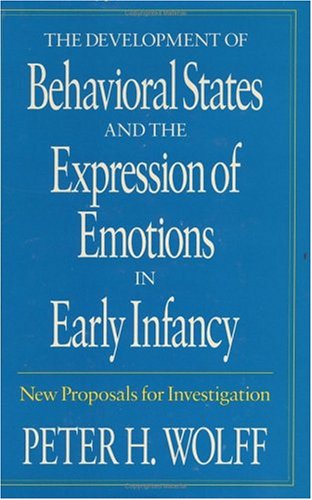
The Development of Behavioral States and the Expression of Emotions in Early Infancy: New Proposals for Investigation by Peter H. Wolff

The Development of Behavioral States and the Expression of Emotions in Early Infancy: New Proposals for Investigation

Peter H. Wolff
300 pages
University of Chicago Press
Feb 1987
Hardcover
Psychology & Philosophy WSBN
0
Readers
0
Reviews
0
Discussions
0
Quotes
Peter H. Wolff, a world-renowned authority on infant behavior, helped lay the foundation for the field in the 1960s with his innovative studies of behavioral studies, motor coordination, smiling, and crying in infancy. Some twenty years later, as infancy studies have become increasingly specialized and fragmented, he calls for new theoretical perspectives and methods of investigation. Applying ethological methods used in field studies of animal behavior, Wolff first observes how babies behave in the "natural" ecology of their homes to catalog their species-typical behavioral repertory and then manipulates their behavior through informal experiments designed to examine functional significance. . Wolff argues that a coherent psychobiological theory of early human development must begin with knowledge about the infant's behavioral repertory under free field conditions. Many current theories of human development begin instead with assumptions about the organization of behavior derived from studies of psychological function in the adult; moreover, they appeal to instincts, maturational programs, or genomes to explain the apparent lawfulness in the development of these behavioral categories. Such a priori explanations, Wolff contends, beg the whole question of development. As an alternative to theoretical metaphors that portray the infant as a closed system and suggests that development is controlled by prescient programs that anticipate the mature steady state, Wolff proposes a metaphor of the infant as an open, self-organizing system with partial, mutative mechanisms of development. Applying this metaphor, he addresses the essentially unsolved problem of how novel behavioral forms are induced during ontogenesis. . Wolff presents a study of twenty-two infants who were observed for thirty hours each week in their homes during the first months after birth. He builds a week-by-week description of changes in behavioral states of wakefulness and examines how reversible state changes influence developmental transformations in social-affective behavior and sensori-motor intelligence. The observations and informal experiments emphasize expressions of emotion and the infant's changing relations to persons and things. Pointing out that movements are our only clue to what infants "feel" or "think," Wolff gives special emphasis to the systematic variations in spontaneous and environmentally evoked patterns of motor coordination as a function of behavioral state transitions. . Of great importance to psychologists, psychiatrists, pediatricians, and students of development in general, The Development of Behavioral States and the Expression of Emotions in Early Infancy offers a major empirical, methodological, and theoretical rethinking of the subject to which Wolff has made outstanding contributions.
Join the conversation

No discussions yet. Join BookLovers to start a discussion about this book!

No reviews yet. Join BookLovers to write the first review!

No quotes shared yet. Join BookLovers to share your favorite quotes!

Earn Points
Your voice matters. Every comment, review, and quote earns you reward points redeemable for Bitcoin.
Comment +5 pts Review +20 pts Quote +7 pts Upvote +1 pt
BookMatch Quiz
Find books similar to this one
About this book
Pages 300
Publisher University of Chicag...
Published 1987
Readers 0