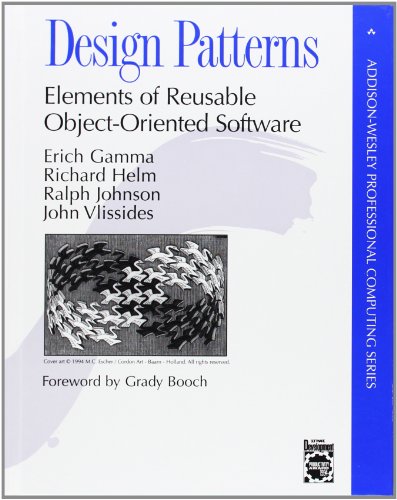
Design Patterns: Elements of Reusable Object-Oriented Software by Erich Gamma

Design Patterns: Elements of Reusable Object-Oriented Software

Erich Gamma
416 pages
Addison-Wesley
Nov 1994
Hardcover
Computers & Internet WSBN
4
Readers
1
Reviews
0
Discussions
0
Quotes
* Capturing a wealth of experience about the design of object-oriented software, four top-notch designers present a catalog of simple and succinct solutions to commonly occurring design problems. Previously undocumented, these 23 patterns allow designers to create more flexible, elegant, and ultimately reusable designs without having to rediscover the design solutions themselves. * The authors begin by describing what patterns are and how they can help you design object-oriented software. They then go on to systematically name, explain, evaluate, and catalog recurring designs in object-oriented systems. With Design Patterns as your guide, you will learn how these important patterns fit into the software development process, and how you can leverage them to solve your own design problems most efficiently.

No discussions yet. Join BookLovers to start a discussion about this book!

An absolute masterpiece even in 2022 - Evergreen Principles of Software Architecture

This book characterizes the kind of thinking that moves you from the low-level 'small' view of a software developer to the high level long-term view of a software architect. While entry-level and junior developers may spent hours arguing fruitlessly over whether OOP is dead or alive, or whether functional programming is better or worse, most senior engineers and software architects are able to use many different paradigms. They understand that these patterns are deeper than the paradigm they are implemented in. They understand that the concepts and ideas underlying these design patterns cannot and will not ever die because they express evergreen solutions to dealing with evolving software systems. Javascript made the prototype pattern its object model. Generators (and coroutines) that make async/await possible are often implemented as combinations of Factories and Iterators. The Observer pattern underlies almost every single reactive UI framework and most micro-service architectures. Decorators have become mainstays in most languages, inversion of control (IoC) is crucial for dependency injection patterns (Angular, etc.), and on and on... In short... these patterns are used absolutely everywhere, yes, even today. Basically, anyone who says these patterns are dead is either profoundly confused or unaware of how prevalent they are underneath everything they do. For those who say you don't need to know the patterns themselves because they are implemented as language features in modern languages... I would say that coders are generally afraid to use what they don't understand. Have you ever seen someone try to do reactive state management well who didn't understand the Observer pattern? It's not pretty. Moreover, there is no language that offers every single one of these patterns as first-class objects, and certainly no language that has them tailor-made for your use case and your business logic. Understanding the problems that these design patterns solve will help y...

No quotes shared yet. Join BookLovers to share your favorite quotes!