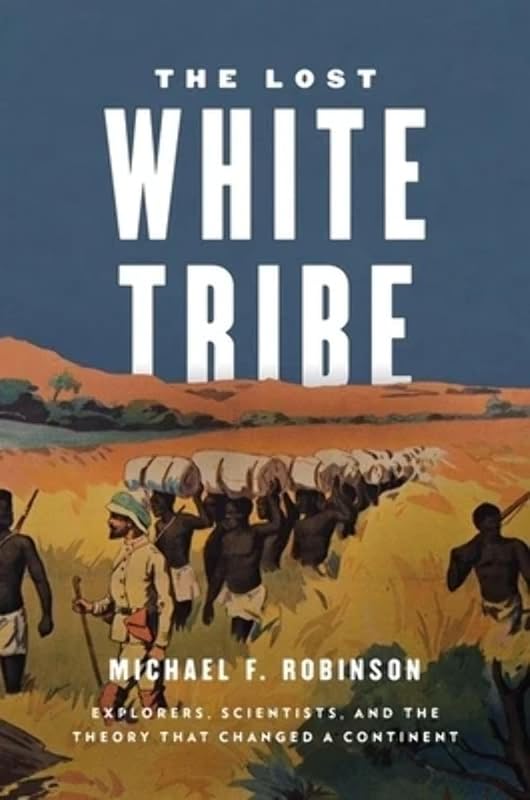
The Lost White Tribe: Explorers, Scientists, and the Theory that Changed a Continent by Michael F. Robinson

The Lost White Tribe: Explorers, Scientists, and the Theory that Changed a Continent

Michael F. Robinson
320 pages
Oxford University Press
Apr 2016
Hardcover
History WSBN
0
Readers
0
Reviews
0
Discussions
0
Quotes
In 1876, in a mountainous region to the west of Lake Victoria, Africa--what is today Ruwenzori Mountains National Park in Uganda--the famed explorer Henry Morton Stanley encountered Africans with what he was convinced were light complexions and European features. Stanley's discovery of this African "white tribe" haunted him and seemed to substantiate the so-called Hamitic Hypothesis: the theory that the descendants of Ham, the son of Noah, had populated Africa and other remote places, proving that the source and spread of human races around the world could be traced to and explained by a Biblical story.. In The Lost White Tribe, Michael Robinson traces the rise and fall of the Hamitic Hypothesis. In addition to recounting Stanley's "discovery," Robinson shows how it influenced encounters with the Ainu in Japan; Vilhjalmur Stefansson's tribe of "blond Eskimos" in the Arctic; and the "white Indians" of Panama. As Robinson shows, race theory stemming originally from the Bible only not only guided exploration but archeology, including Charles Mauch's discovery of the Grand Zimbabwe site in 1872, and literature, such as H. Rider Haggard's King Solomon's Mines, whose publication launched an entire literary subgenre ded icated to white tribes in remote places. The Hamitic Hypothesis would shape the theories of Carl Jung and guide psychological and anthropological notions of the primitive.. The Hypothesis also formed the foundation for the European colonial system, which was premised on assumptions about racial hierarchy, at whose top were the white races, the purest and oldest of them all. It was a small step from the Hypothesis to theories of Aryan superiority, which served as the basis of the race laws in Nazi Germany and had horrific and catastrophic consequences. Though racial thinking changed profoundly after World War Two, a version of Hamitic validation of the "whiter" tribes laid the groundwork for conflict within Africa itself after decolonization, including the Rwandan genocide. . Based on painstaking archival research, The Lost White Tribe is a fascinating, immersive, and wide-ranging work of synthesis, revealing the roots of racial thinking and the legacies that continue to exert their influence to this day.
Join the conversation

No discussions yet. Join BookLovers to start a discussion about this book!

No reviews yet. Join BookLovers to write the first review!

No quotes shared yet. Join BookLovers to share your favorite quotes!

Earn Points
Your voice matters. Every comment, review, and quote earns you reward points redeemable for Bitcoin.
Comment +5 pts Review +20 pts Quote +7 pts Upvote +1 pt
BookMatch Quiz
Find books similar to this one
About this book
Pages 320
Publisher Oxford University Pr...
Published 2016
Readers 0