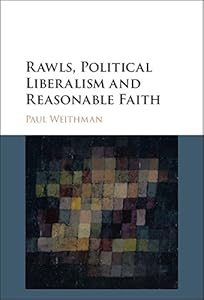
Why Political Liberalism?: On John Rawls's Political Turn (Oxford Political Philosophy) by Paul Weithman

Why Political Liberalism?: On John Rawls's Political Turn (Oxford Political Philosophy)

Paul Weithman
400 pages
Oxford University Press
Feb 2011
Hardcover
Politics WSBN
0
Readers
0
Reviews
0
Discussions
0
Quotes
In WHY POLITICAL LIBERALISM?, Paul Weithman offers a fresh, rigorous, and compelling interpretation of John Rawls's reasons for taking his so-called "political turn". Weithman takes Rawls at his word that justice as fairness was recast as a form of political liberalism because of an inconsistency Rawls found in his early treatment of social stability. He argues that the inconsistency is best seen by identifying the threats to stability with which the early Rawls was concerned. One of those threats, often overlooked by Rawls's readers, is the threat that the justice of a well-ordered society would be undermined by a generalized prisoner's dilemma. Showing how the Rawls of "A Theory of Justice" tried to avert that threat shows that the much-neglected third part of that book is of considerably greater philosophical interest, and has considerably more unity of focus, than is generally appreciated.

Weithman painstakingly reconstructs Rawls's attempts to show that a just society would be stable, and just as carefully shows why Rawls came to think those arguments were inconsistent with other parts of his theory. Weithman then shows that the changes Rawls introduced into his view between "Theory of Justice" and "Political Liberalism" result from his attempt to remove the inconsistency and show that the hazard of the generalized prisoner's dilemma can be averted after all. Recovering Rawls's two treatments of stability helps to answer contested questions about the role of the original position and the foundations of justice as fairness. The result is a powerful and unified reading of Rawls's work that explains his political turn and shows his enduring engagement with some of the deepest concerns of human life.


Read more Continue reading Read less REVIEW
"Unfortunately for the Rawls weary, Weithman's, Why Political Liberalism? On John Rawls's Political Turn, is excellent. It both justifies the current focus on Rawls (especially his later work) and manages to push Rawls scholarship in new and innovative directions."
--Kevin Vallier, Journal of Moral Philosophy


"Why Political Liberalism? offers an extraordinarily close and perceptive reading of Rawls, one strikingly different from those currently on offer."--Terence Cuneo, Faith and Philosophy

"Paul Weithman has written an original, important, and enlightening study of Rawl's 'political turn'." --Ethics

"Why Political Liberalism? is a wonderful book, one that is required reading for anyone with an interest in Rawls's political philosophy."--Notre Dame Philosophical Review

"Paul Weithman has written what is undoubtedly the most patient, probing, and imaginative study we have of John Rawls' 'political liberalism'. Explaining the reasons for the dramatic shift in Rawls' later thinking about the nature of justice and political society, Weithman also shows why this reorientation ought to engage the attention of anyone who cares about liberal ideals and the fate of democratic institutions. This book is not only an interpretive work of the first order. It also constitutes a distinctive theoretical achievement in its own right." --Charles Larmore, Brown University


"Weithman's reconstruction of Rawls's arguments is masterful, convincing and in many ways revelatory. Readers will find that the text provides compelling answers to a lot of puzzling questions about Rawls's project that have lingered for some time. Perhaps most importantly, Weithman gives the best explanation to date of exactly why Rawls felt compelled to revise his theory as he did." -- Colin Bird, Department of Politics, University of Virginia

"Weithman has written a masterful work of Rawls scholarship. This book will deepen our understanding of how and why Rawls restructured his theory, and illuminate this fascinating transition in the history of political philosophy." -- Leif Wenar, Chair of Ethics, Kings College London

"Weithman's account has much to offer and has the added benefit of drawing attention to themes in Rawls's work too often overlooked...the book makes an important case."--American Catholic Philosophical Quarterly

ABOUT THE AUTHOR
Paul Weithman is Professor of Philosophy, University of Notre Dame Read more Continue reading Read less
Join the conversation

No discussions yet. Join BookLovers to start a discussion about this book!

No reviews yet. Join BookLovers to write the first review!

No quotes shared yet. Join BookLovers to share your favorite quotes!

Earn Points
Your voice matters. Every comment, review, and quote earns you reward points redeemable for Bitcoin.
Comment +5 pts Review +20 pts Quote +7 pts Upvote +1 pt
BookMatch Quiz
Find books similar to this one
About this book
Pages 400
Publisher Oxford University Pr...
Published 2011
Readers 0