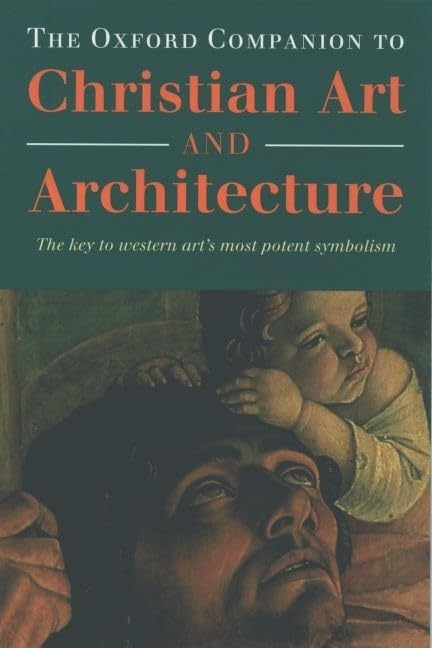
The Oxford Companion to Christian Art and Architecture
Peter Murray
The Judeo-Christian tradition has had a profound impact on Western civilization and in particular on Western art. From the flying buttresses and soaring vaults of the Gothic cathedral, to Michelangelo's powerfully rendered frescoes in the Sistine Chapel, to the great bronze baptistery doors in Florence, to Marc Chagall's majestic tapestries for the Knesset in Jerusalem, biblical stories and Christian themes form an integral part in our artistic heritage. But today, a lack of knowledge of the Bible and of Christian doctrine, as well as of church history and of ritual, frequently prevents us from understanding--and appreciating--much of the greatest art that has ever been created. Exquisitely designed and lavishly illustrated--with over 200 pictures, including 16 color plates--The Oxford Companion to Christian Art and Architecture offers a goldmine of information on the Judeo-Christian tradition as it applies to Western art. Here are over 1700 alphabetical entries that cover everything from Adam and Eve and the Good Samaritan, to Illuminated Books and Rose Windows, to the great popes and emperors who patronized the arts, to the major artists whose work reflects Judeo-Christian themes. Indeed, readers will find entries on virtually every aspect of the topic: detailed essays on periods and styles in art and architecture, from the Byzantine and the Coptic, to the Gothic, the Romanesque, and the Renaissance; biographical entries on major artists (Giotto, Fra Angelico, Donatello, Michelangelo, Raphael, Leonardo da Vinci, Titian, Rubens, and many more) , on saints, popes, and patrons (including Saints Peter, Paul, Jerome, and Sebastian, Popes Urban VIII and Clement VII, and Emperors Charlemagne and Constantine) and on major biblical figures (such as Moses and Jesus, Mary and Joseph, Salome and Bathsheba) ; and briefer entries on icons and symbols (rainbow, dove, the Wheel of Fortune) ; on art forms influenced by Christian ideas (stained glass, mosaics, frescoes, altarpieces, and rose windows) ; and on general beliefs (the liturgical year, colors, vessels, Holy Week, and much more) . And throughout the book, the Murrays continually interconnect the religious and the artistic. When discussing Moses, for instance, after providing an engaging account of his life, they examine the many works of art that feature Moses (they even explain why Michelangelo's Moses depicts him with "horns" on his head) . Likewise, in the entry on Rembrandt (whom the Murrays call "the greatest religious painter in the Protestant tradition") , the authors focus on Rembrandt's religious works and describe how they reflect Protestant views (haloes are extremely rare, for instance, and "Catholic" subjects such as martyrdom are completely absent) . Finally, the authors provide an informative glossary of architectural terms, and conclude with an extensive bibliography based on the Murrays' own personal library of art books. Attractively illustrated, wide ranging, and informative, The Oxford Companion to Christian Art and Architecture is a unique resource on a major aspect of Western art. It is an essential work for museum-goers and for all lovers of fine painting, sculpture, and architecture.