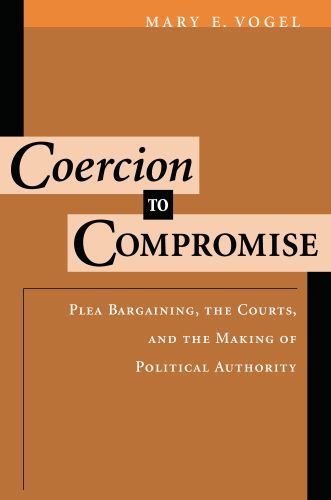
Coercion to Compromise: Plea Bargaining, the Courts, and the Making of Political Authority (Oxford Socio-Legal Studies) by Mary E. Vogel

Coercion to Compromise: Plea Bargaining, the Courts, and the Making of Political Authority (Oxford Socio-Legal Studies)

Mary E. Vogel
448 pages
Oxford University Press
Nov 2007
Hardcover
Professional & Technical WSBN
0
Readers
0
Reviews
0
Discussions
0
Quotes
Plea bargaining is one of the most striking features of American courts. The vast majority of criminal convictions today are produced through bargained pleas. Where does the practice come from? Whose interests does it serve? Often plea bargaining is imagined as a corruption of the court during the post-World War II years, paradoxically rewarding those who appear guilty rather than those claiming innocence. Yet, as Mary Vogel argues in this pathbreaking history, plea bargaining's roots are deeper and more distinctly American than is commonly supposed.. During the Age of Jackson, amidst crime and violence wrought by social change, the courts stepped forward as agents of the state to promote the social order. Plea bargaining arose during the 1830s and 1840s as part of this process of political stabilization and an effort to legitimate institutions of self-rule--accomplishments that were vital to Whig efforts to restore order and reconsolidate their political power. To this end, the tradition of episodic leniency from British common law was recrafted into a new cultural form--plea bargaining--that drew conflicts into the courts while maintaining elite discretion over sentencing policy.. In its reliance on the mechanism of leniency, the courts were attempting a sort of social "triage"--sorting those who could be reclaimed as industrious and productive citizens from marginals and transients. The "worthy" often paid fines and were returned to their community under the watchful eyes of their intercessors and that most powerful web of social control, that of everyday life.. Created during a period of social mobility, plea bargaining presumed that those with much to lose through conviction would embrace individual reform. Today, when many defendants who come before the court have much less in the way of prospects to lose, leniency may be more likely to be regarded with cynicism, as an act of weakness by the state, and plea bargaining may grow more problematic.
Join the conversation

No discussions yet. Join BookLovers to start a discussion about this book!

No reviews yet. Join BookLovers to write the first review!

No quotes shared yet. Join BookLovers to share your favorite quotes!

Earn Points
Your voice matters. Every comment, review, and quote earns you reward points redeemable for Bitcoin.
Comment +5 pts Review +20 pts Quote +7 pts Upvote +1 pt
BookMatch Quiz
Find books similar to this one
About this book
Pages 448
Publisher Oxford University Pr...
Published 2007
Readers 0