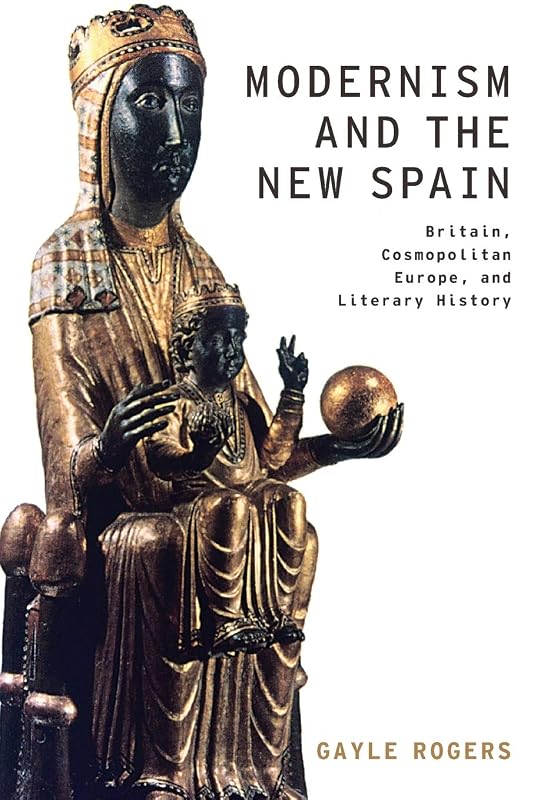

Modernism and the New Spain: Britain, Cosmopolitan Europe, and Literary History (Modernist Literature and Culture) by Gayle Rogers

Modernism and the New Spain: Britain, Cosmopolitan Europe, and Literary History (Modernist Literature and Culture)

Gayle Rogers
304 pages
Oxford University Press
Dec 2014
Paperback
Spanish WSBN
0
Readers
0
Reviews
0
Discussions
0
Quotes

Free account. We’ll keep this book ready while you join.

Find a copy

Formats and availability vary by store. As an Amazon Associate I earn from qualifying purchases.

How and why did a country seen as remote, backwards, and barely European become a pivotal site for reinventing the continent after the Great War? Modernism and the New Spain argues that the "Spanish problem"-the nation's historically troubled relationship with Europe-provided an animating impulse for interwar literary modernism and for new conceptions of cosmopolitanism. Drawing on works in a variety of genres, Gayle Rogers reconstructs an archive of cross-cultural exchanges to reveal the mutual constitution of two modernist movements-one in Britain, the other in Spain, and stretching at key moments in between to Ireland and the Americas. . Several sites of transnational collaboration form the core of Rogers's innovative literary history. The relationship between T. S. Eliot's Criterion and José Ortega y Gasset's Revista de Occidente shows how the two journals joined to promote a cosmopolitan agenda. A similar case of kindred spirits appears with the 1922 publication of Joyce's Ulysses. The novel's forward-thinking sentiments on race and nation resonated powerfully within Spain, where a generation of writers searched for non-statist forms through which they might express a new European Hispanicity. These cultural ties between the Anglo-Irish and Spanish-speaking worlds increased with the outbreak of civil war in 1936. Rogers explores the connections between fighting Spanish fascism and dismantling the English patriarchal system in Virginia Woolf's Three Guineas, along with the international, anti-fascist poetic community formed by Stephen Spender, Manuel Altolaguirre, and others as they sought to establish Federico García Lorca as an apolitical Spanish-European poet.. Mining a rich array of sources that includes novels, periodicals, biographies, translations, and poetry in English and in Spanish, Modernism and the New Spain adds a vital new international perspective to modernist studies, revealing how writers created alliances that unified local and international reforms to reinvent Europe not in the London-Paris-Berlin nexus, but in Madrid.
Join the conversation

No discussions yet. Join BookLovers to start a discussion about this book!

No reviews yet. Join BookLovers to write the first review!

No quotes shared yet. Join BookLovers to share your favorite quotes!

Earn Points
Your voice matters. Every comment, review, and quote earns you reward points redeemable for Bitcoin.
Comment +5 pts Review +20 pts Quote +7 pts Upvote +1 pt
Similar Books
Find books similar to this one
About this book
Pages 304
Publisher Oxford University Pr...
Published 2014
Readers 0