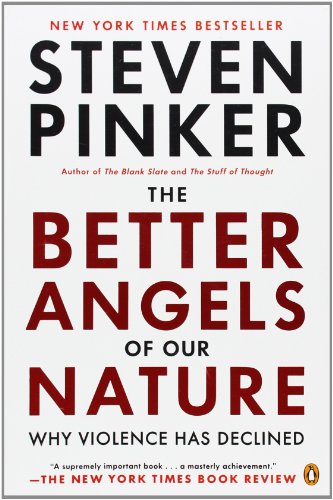
The Better Angels of Our Nature: Why Violence Has Declined by Steven Pinker

The Better Angels of Our Nature: Why Violence Has Declined

Steven Pinker
802 pages
Penguin Books
Sep 2012
Psychology & Philosophy WSBN
4
Readers
1
Reviews
0
Discussions
0
Quotes
<b>A provocative history of violence - from the <i>New York Times</i> bestselling author of <i>The Stuff of Thought</i> and <i>The Blank Slate</i></b><p></p><p>Believe it or not, today we may be living in the most peaceful moment in our species' existence. In his gripping and controversial new work, <i>New York Times</i> bestselling author Steven Pinker shows that despite the ceaseless news about war, crime, and terrorism, violence has actually been in decline over long stretches of history. Exploding myths about humankind's inherent violence and the curse of modernity, this ambitious book continues Pinker's exploration of the essence of human nature, mixing psychology and history to provide a remarkable picture of an increasingly enlightened world.</p><p></p>

No discussions yet. Join BookLovers to start a discussion about this book!

The most important book written in a very long time

One of these days I'm going to sit down and make a list of the Top 100 nonfiction books that everyone absolutely must read if they really want to understand the world we live in. And, when I do, this book by the noted experimental psychologist and cognitive scientist Steven Pinker will definitely make the Top Ten. In fact, I'm even tempted to say that this might very well be the most important book of the 21st century thus far. Okay, I'll admit that I might be just a little bit biased in this assessment, because this book deals, in large part, with my two main areas of study as a political scientist: international relations, with a focus on war and international security, and comparative politics, with a focus on political development and modernization. In fact, this book bridges these two topics by showing how modernization has helped make the world more peaceful. (And if you don't believe that the world is a lot more peaceful today than it was at any time in the past, you really do need to read this book.) When I was in grad school (where I studied under John A. Vasquez and James Lee Ray, two of the world's leading experts on war and peace, both of whom are cited in Pinker's book) my main focus was on the scientific study of international militarized conflict, using quantitative methods such as statistical analysis and game theory in order to better understand why nations go to war and what it takes to maintain the peace. This particular subfield of international relations (which is sometimes referred to as "peace science") aims to identify historical patterns and trends in international conflict, to find variables that correlate well with war (or with peace), to assess the probability that an international crisis will escalate to the use of military force, and to evaluate foreign policy alternatives to see which are more likely to provoke war and which are more likely to promote peace. Although peace science is usually viewed as a subfield of international rel...

No quotes shared yet. Join BookLovers to share your favorite quotes!