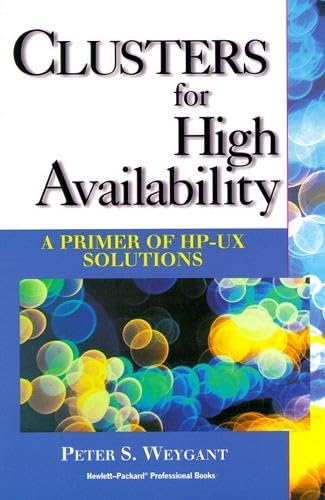
Clusters for High Availability: A Primer of HP-UX Solutions by Peter Weygant

Clusters for High Availability: A Primer of HP-UX Solutions

Peter Weygant
192 pages
Prentice Hall
Jan 1996
Paperback
Computers & Internet WSBN
0
Readers
0
Reviews
0
Discussions
0
Quotes
49475-7 UNIX(r) computer systems are increasingly used for mission-critical applications, data processing organizations are required to provide high levels of availability for these systems and to ensure they maintain the required level of availability over time. Among the most reliable, cost-effective ways to deliver high availability is to use clusters-loosely coupled UNIX computers, each with its own processors, memory, operating system and storage, bound together by special system processes. Clusters for High Availability explains the basic concepts, architectures and terminology of high availability using clusters, and gives a broad outline of how Hewlett-Packard's industry-leading cluster solutions work. The book describes how high-availability clusters can be configured to eliminate single points of failure in power systems, disks, processors, network components, and software. The book features coverage of HP high-availability products, including MC/ServiceGuard, MC/LockManager, mirrored disks and disk arrays, journaled file systems, management tools, and consulting services. Finally, Clusters for High Availability presents suggestions for developing high availability solutions in areas as diverse as publishing, mail order catalog sales, brokerage services, and insurance.
Join the conversation

No discussions yet. Join BookLovers to start a discussion about this book!

No reviews yet. Join BookLovers to write the first review!

No quotes shared yet. Join BookLovers to share your favorite quotes!

Earn Points
Your voice matters. Every comment, review, and quote earns you reward points redeemable for Bitcoin.
Comment +5 pts Review +20 pts Quote +7 pts Upvote +1 pt
BookMatch Quiz
Find books similar to this one
About this book
Pages 192
Publisher Prentice Hall
Published 1996
Readers 0