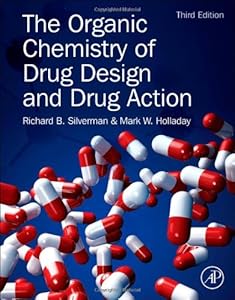
The Organic Chemistry of Drug Design and Drug Action by Richard B. Silverman Ph.D Organic Chemistry

The Organic Chemistry of Drug Design and Drug Action

Richard B. Silverman Ph.D Organic Chemistry
536 pages
Academic Press
Jun 2014
Hardcover
All Non-Fiction WSBN
0
Readers
0
Reviews
0
Discussions
0
Quotes
The Organic Chemistry of Drug Design and Drug Action, Third Edition, represents a unique approach to medicinal chemistry based on physical organic chemical principles and reaction mechanisms that rationalize drug action, which allows reader to extrapolate those core principles and mechanisms to many related classes of drug molecules.This new edition includes updates to all chapters, including new examples and references. It reflects significant changes in the process of drug design over the last decade and preserves the successful approach of the previous editions while including significant changes in format and coverage.This text is designed for undergraduate and graduate students in chemistry studying medicinal chemistry or pharmaceutical chemistry; research chemists and biochemists working in pharmaceutical and biotechnology industries.Updates to all chapters, including new examples and referencesChapter 1 (Introduction) : Completely rewritten and expanded as an overview of topics discussed in detail throughout the bookChapter 2 (Lead Discovery and Lead Modification) : Sections on sources of compounds for screening including library collections, virtual screening, and computational methods, as well as hit-to-lead and scaffold hopping; expanded sections on sources of lead compounds, fragment-based lead discovery, and molecular graphics; and deemphasized solid-phase synthesis and combinatorial chemistryChapter 3 (Receptors) : Drug-receptor interactions, cation-p and halogen bonding; atropisomers; case history of the insomnia drug suvorexantChapter 4 (Enzymes) : Expanded sections on enzyme catalysis in drug discovery and enzyme synthesisChapter 5 (Enzyme Inhibition and Inactivation) : New case histories:for competitive inhibition, the epidermal growth factor receptor tyrosine kinase inhibitor, erlotinib and Abelson kinase inhibitor, imatinibfor transition state analogue inhibition, the purine nucleoside phosphorylase inhibitors, forodesine and DADMe-ImmH, as well as the mechanism of the multisubstrate analog inhibitor isoniazidfor slow, tight-binding inhibition, the dipeptidyl peptidase-4 inhibitor, saxagliptinChapter 7 (Drug Resistance and Drug Synergism) : This new chapter includes topics taken from two chapters in the previous edition, with many new examplesChapter 8 (Drug Metabolism) : Discussions of toxicophores and reactive metabolitesChapter 9 (Prodrugs and Drug Delivery Systems) : Discussion of antibody-drug conjugates
Join the conversation

No discussions yet. Join BookLovers to start a discussion about this book!

No reviews yet. Join BookLovers to write the first review!

No quotes shared yet. Join BookLovers to share your favorite quotes!

Earn Points
Your voice matters. Every comment, review, and quote earns you reward points redeemable for Bitcoin.
Comment +5 pts Review +20 pts Quote +7 pts Upvote +1 pt
BookMatch Quiz
Find books similar to this one
About this book
Pages 536
Publisher Academic Press
Published 2014
Readers 0

More by Richard B. Silverman Ph.D Organic Chemistry

View All