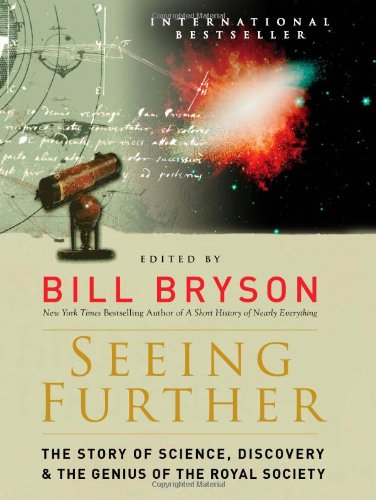
Seeing Further: The Story of Science, Discovery, and the Genius of the Royal Society by Bill Bryson

Seeing Further: The Story of Science, Discovery, and the Genius of the Royal Society

Bill Bryson
William Morrow; 1 edition
Nov 2010
Hardcover
WSBN
2
Readers
1
Reviews
0
Discussions
0
Quotes
Edited and introduced by Bill Bryson, with original contributions from "a glittering array of scientific writing talent" (Sunday Observer) including Richard Dawkins, Margaret Atwood, Richard Holmes, Martin Rees, Richard Fortey, Steve Jones, James Gleick, and Neal Stephenson, among others, this incomparable book tells the spectacular story of science and the international Royal Society, from 1660 to the present. Seeing Further is also gorgeously illustrated with photographs, documents, and treasures from the Society's exclusive archives. On a damp weeknight in November three hundred and fifty years ago, a dozen men gathered in London. After hearing an obscure twenty-eight-year-old named Christopher Wren lecture on the wonders of astronomy, his rapt audience was moved to create a society to promote the accumulation of useful—and fascinating—knowledge.
Join the conversation

No discussions yet. Join BookLovers to start a discussion about this book!

A great read for the person with general knowledge about science.

Seeing Further: The Story of Science, Discovery & the Genius of the Royal Society with Bill Bryson as the editor is a marvelous book. I have read thousands of times that the pace of science and innovation causes knowledge to double and replace itself at an alarmingly fast rate. Of course, it's not in the actual doubling of knowledge that a problem exists but in the fact that it is virtually impossible for us to keep track of that very same new knowledge. However, even in a world that is creating so much new knowledge it is reassuring to consider that the Royal Society is celebrating its 350th anniversary this year. That is a marvelous accomplishment and to be honest I can't name many institutions that have been around that long. Bill Bryson is the perfect person to have headed this project. As a general science writer Bryson is aware of how important science and the Royal Society has been to the development of modern society. Then there is the rather eclectic group of contributors that have each offered a discussion on the development of science. Authors include James Gleick, Margaret Atwood, Margaret Wertheim, Neal Stephenson, Rebecca Newberger Goldstein, Simon Schaffer, Richard Holmes, Richard Fortey, Richard Dawkins, Henry Petroski, Georgiana Ferry, Steve Jones, Philip Ball, Paul Davies, Ian Stewart, John D. Barrow, Oliver Morton, Maggie Gee, Stephen H. Schneider, Gregory Benford, and Martin Rees. I'd have to admit that Margaret Atwoods discussion of Jonathan Swift's Academy, and Richard Dawkins' Darwin's Five Bridges: The Way to Natural Selection is for me the highlight of the book. However, each and every chapter is eye opening and worthy of your time. It is a difficult fact to get your head around that when the Royal Society was established in 1660 we knew so little of the causes of the physical phenomenon of our planet. Whether the topic was the causes of the tides or why summer was warmer than winter, mystery tended to shroud almost everything. The Royal ...

No quotes shared yet. Join BookLovers to share your favorite quotes!

Earn Points
Your voice matters. Every comment, review, and quote earns you reward points redeemable for Bitcoin.
Comment +5 pts Review +20 pts Quote +7 pts Upvote +1 pt
BookMatch Quiz
Find books similar to this one
About this book
Publisher William Morrow; 1 ed...
Published 2010
Readers 2