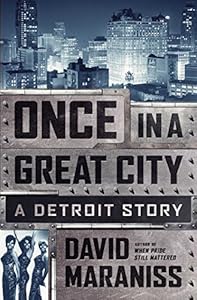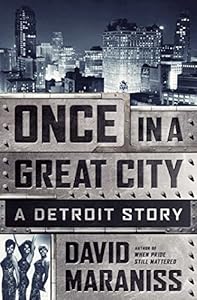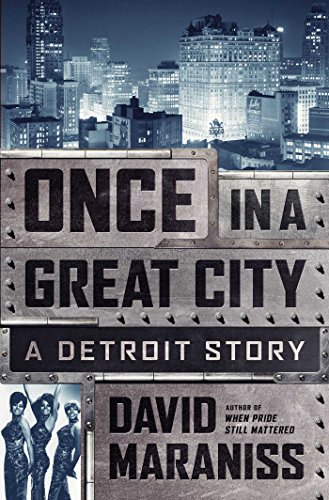
Once in a Great City: A Detroit Story by David Maraniss

Once in a Great City: A Detroit Story
David Maraniss
441 pages
Simon & Schuster
Sep 2015
Arts & Photography WSBN
2
Readers
1
Reviews
0
Discussions
0
Quotes
<b>* Winner - Robert F. Kennedy Book Award (2016) *</b><br> <br><b>&quot;Elegiac and richly detailed...[Maraniss] succeeds with authoritative, adrenaline-laced flair...evocative.&quot; - Michiko Kakutani for <i>The New York Times</i></b><br> <br>As David Maraniss captures it with power and affection, Detroit summed up America's path to music and prosperity that was already past history.<br><br>It's 1963 and Detroit is on top of the world. The city's leaders are among the most visionary in America: Grandson of the first Ford; Henry Ford II; influential labor leader Walter Reuther; Motown's founder Berry Gordy; the Reverend C.L. Franklin and his daughter, the amazing Aretha; Governor George Romney, Mormon and Civil Rights advocate; super car salesman Lee Iacocca; Mayor Jerome Cavanagh, a Kennedy acolyte; Police Commissioner George Edwards; Martin Luther King. It was the American auto makers' best year; the revolution in music and politics was underway. Reuther's UAW had helped lift the middle class.<br> <br>The time was full of promise. The auto industry was selling more cars than ever before and inventing the Mustang. Motown was capturing the world with its amazing artists. The progressive labor movement was rooted in Detroit with the UAW. Martin Luther King delivered his &quot;I Have a Dream&quot; speech there two months before he made it famous in the Washington march.<br> <br><i>Once in a Great City</i> shows that the shadows of collapse were evident even then. Before the devastating riot. Before the decades of civic corruption and neglect, and white flight. Before people trotted out the grab bag of rust belt infirmities - from harsh weather to high labor costs - and competition from abroad to explain Detroit's collapse, one could see the signs of a city's ruin. Detroit at its peak was threatened by its own design. It was being abandoned by the new world. Yet so much of what Detroit gave America lasts.

No discussions yet. Join BookLovers to start a discussion about this book!

including a brilliant biography of Vince Lombardi

Even though I have never lived there, I feel a connection with Detroit. My father was born and raised there, I still have some family there,and I was there a few times as a child in what were still the city's glory days. I saw a game at Tiger Stadium, toured a Ford factory (very hot and noisy) and saw a vibrant, dynamic downtown. More than that, as a history buff, Detroit has always fascinated me as, first, the Arsenal of Democracy during World War II, then the engine (no pun intended) of American prosperity during the Cold War, and, finally and sadly, of course, the ultimate symbol of American urban decline. David Maraniss was a reporter for the Washington Post and has written a number of other books, including a brilliant biography of Vince Lombardi, which I highly recommend. He was born in Detroit although his family moved when he was young. I think this is a great book. The book covers the time period roughly from late 1962 to late 1964, with the emphasis being on 1963, a time when America was truly on top of the world although cracks were beginning to show. Detroit was at its height; the country as a whole was prosperous, the car industry was booming, and no one, I'm sure, could possibly have imagined a time when Japanese cars would be a serious threat to the Ford, Chrysler, and GM. Detroit was a vibrant, dynamic city which, in fact, even bid on the 1968 Summer Olympics, a fact which astonished me; indeed, Detroit was selected over Los Angeles as the American bidder for the games. (The Games eventually went to Mexico City.) It's simply incredibly today to think about Detroit as being a serious competitor for the Olympics. But that's what Detroit was in 1963. And the auto industry helped to create a solid middle class African-American community which, ultimately, fueled the growth of Motown, probably one of, if not the, first large-scale African-American enterprises. The auto industry, despite the racism of many union members (and, yes, they were racists), en...

No quotes shared yet. Join BookLovers to share your favorite quotes!