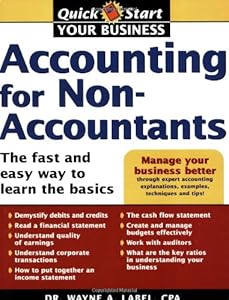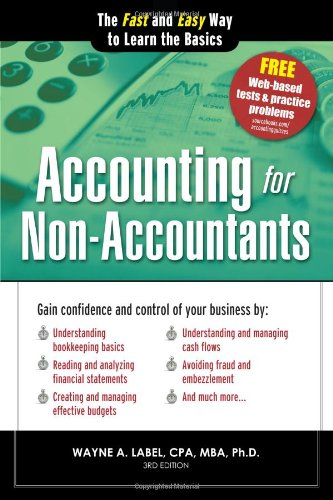
Accounting for Non-Accountants, 3E: The Fast and Easy Way to Learn the Basics (Quick Start Your Business) by Wayne Label

Accounting for Non-Accountants, 3E: The Fast and Easy Way to Learn the Basics (Quick Start Your Business)

Wayne Label
210 pages
Sourcebooks
Jan 2013
Paperback
Business & Investing WSBN
5
Readers
1
Reviews
0
Discussions
0
Quotes
<p>A Quick, Compact, and Easy-to-Understand Resource for Non-Accountants</p> <p>Accounting for Non-Accountants is the must-have guide for all of us who have never taken an accounting class, are mystified by accounting jargon, and have no clue about balance sheets, income statements, or statements of cash flows.</p> <p>Whether you own a business, plan on starting one, or just want to control your own assets, you'll find everything you need to know:</p> <p>* How to prepare and use financial statements<br> * How to control cash flows<br> * How to manage budgets<br> * How to use accounting ratios to<br> * How to deal with audits and auditors interpret financial statements</p> <p>Let this book help you like it helped these readers: </p> <p>&quot;Dr. Labels explanations are simple and straightforward. &quot;<br> &quot;This will help me a lot as I set up my own business. &quot;<br> &quot;I have worked in accounting for over twenty-five years, and this is the best book I have seen to help people with the basics of accounting.&quot;</p> <p>For entrepreneurs or anyone who needs to brush up on accounting fast, this book will have you up and running in no time.</p>
Join the conversation

No discussions yet. Join BookLovers to start a discussion about this book!

straightforward and sequential layout of accounting transactions

Accounting for Non-Accountants by Wayne A. Label is a marvelous little book for getting acquainted with basic financial statements such as, primarily, the Balance Sheet and the Income Statement, in addition to the Statement of Cash Flows and the Statement of Retained Earnings. The book is geared for people new to accounting principles, as it lays out, for instance, different sequential snapshots of the balance sheet to demonstrate how individual adjustments are treated. This is probably the highlight feature of the book for newcomers--its straightforward and sequential layout of accounting transactions. With that said, let it be clear that Label has personality, demonstrated by his occasional use of humor and his engaging writing style. Furthermore, Label covers a large scope of interesting material--not just information on financial statements-- to give beginners a broad overview of the industry. To explain, about half of the book is dedicated to the financial statements, journal, and ledger, while the other half is dedicated to concepts such as fraud prevention, audits, GAAP, and--perhaps most interestingly--ratios (including rate of return on investment, current ration, sales ratios, and many others) for reporting short-term or long-term analysis of financial data. As a specific example of what the book offers, Label expounds on Generally Accepted Accounting Principles (GAAP), which apply to the United States (and Canada, too, so I am told). These principles outline the requirements for accounting, such as both the requirement that financial statements be relayed in monetary terms and the requirement that the depreciation estimates be sufficiently verifiable. As another example, the book provides a somewhat cursory albeit introductory discussion on both the journal and the ledger, while providing a clear definition of the double accounting system, including an accessible definition of the somewhat arbitrary meaning of both credits and debits. Perhaps unique to...

No quotes shared yet. Join BookLovers to share your favorite quotes!

Earn Points
Your voice matters. Every comment, review, and quote earns you reward points redeemable for Bitcoin.
Comment +5 pts Review +20 pts Quote +7 pts Upvote +1 pt
BookMatch Quiz
Find books similar to this one
About this book
Pages 210
Publisher Sourcebooks
Published 2013
Readers 5