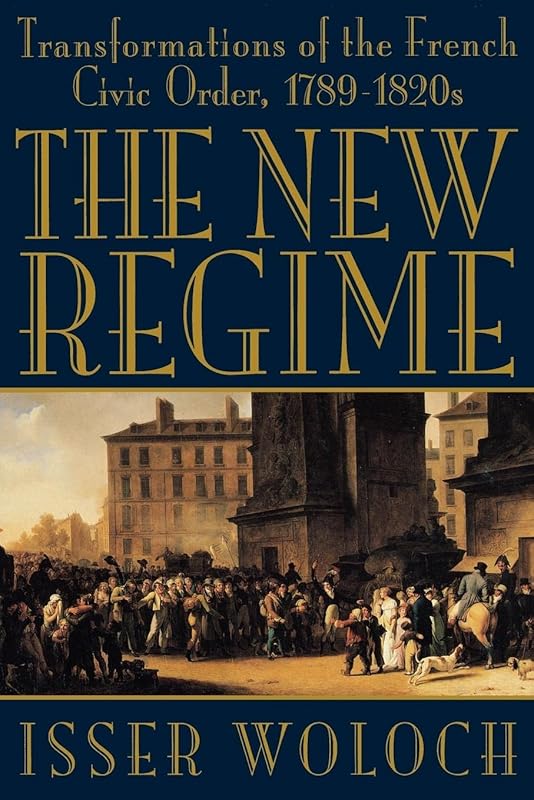
The New Regime: Transformations of the French Civic Order, 1789-1820s by Isser Woloch

The New Regime: Transformations of the French Civic Order, 1789-1820s

Isser Woloch
540 pages
W. W. Norton & Company
Nov 1995
Paperback
History WSBN
0
Readers
0
Reviews
0
Discussions
0
Quotes
"The New Regime is a refreshing departure from [the new revisionist] orthodoxy, Woloch takes a long view of the Revolution, from 1789 to the Restoration, even to 1830, so that the period of the Terror ceases to dominate. He sees the Revolution essentially as a constructive project, which tore down the Old Regime but put in its place a New Regime of revamped central and local government, wider political participation, the establishment of public education and public welfare systems, trial by jury and universal military service. . . . He brings to bear an immense amount of archival research in order to test the success of the revolutionary project. . . . But in spite of that vastness, he writes elegantly, clearly, with a light touch and a certain wit. . . . The most significant contribution of Woloch's book is to highlight the difficulties faced by the architects of the new civic order, and not just in terms of counter-revolutionary or religious opposition. . . . Woloch amply demonstrates that the interests of building the state directly conflicted with the building of the civic order." -- Robert Gildea, Merton College, in Times Literary Supplement Confident that they had broken with a discredited past, French revolutionaries after 1789 referred to pre-revolutionary times as the ancien regime (old regime) . The National Assembly proclaimed the sovereignty of the people, grasping the reins of power and asserting the supremacy of law over all other interests. Even as the liberalism of 1789 collapsed into the Terror and then into the Napoleonic dictatorship, a new regime emerged at the juncture of state and civil society. The cycles of recrimination, hatred, and endemic local conflict unleashed by the Terror did not obliterate this new civic order. In this fascinating and wide-ranging study of three turbulent decades in French history, the eminent historian Isser Woloch examines some large questions: How did the French civic order change after 1789? What civic values animated the new regime; what policies did it adopt? What institutions did it establish, and how did they fare when carried into practice? Drawing on a variety of archival sources, Professor Woloch explains shifts in lawmaking and local authority, state intervention in village life, the creation of public primary schools, experiments in public assistance, a cycle of changes in the mechanisms of civil justice, the introduction of felony trials, and above all the imposition of military conscription.
Join the conversation

No discussions yet. Join BookLovers to start a discussion about this book!

No reviews yet. Join BookLovers to write the first review!

No quotes shared yet. Join BookLovers to share your favorite quotes!

Earn Points
Your voice matters. Every comment, review, and quote earns you reward points redeemable for Bitcoin.
Comment +5 pts Review +20 pts Quote +7 pts Upvote +1 pt
BookMatch Quiz
Find books similar to this one
About this book
Pages 540
Publisher W. W. Norton & Compa...
Published 1995
Readers 0